
Sep 21
Remembering Korean Air Lines Flight 007
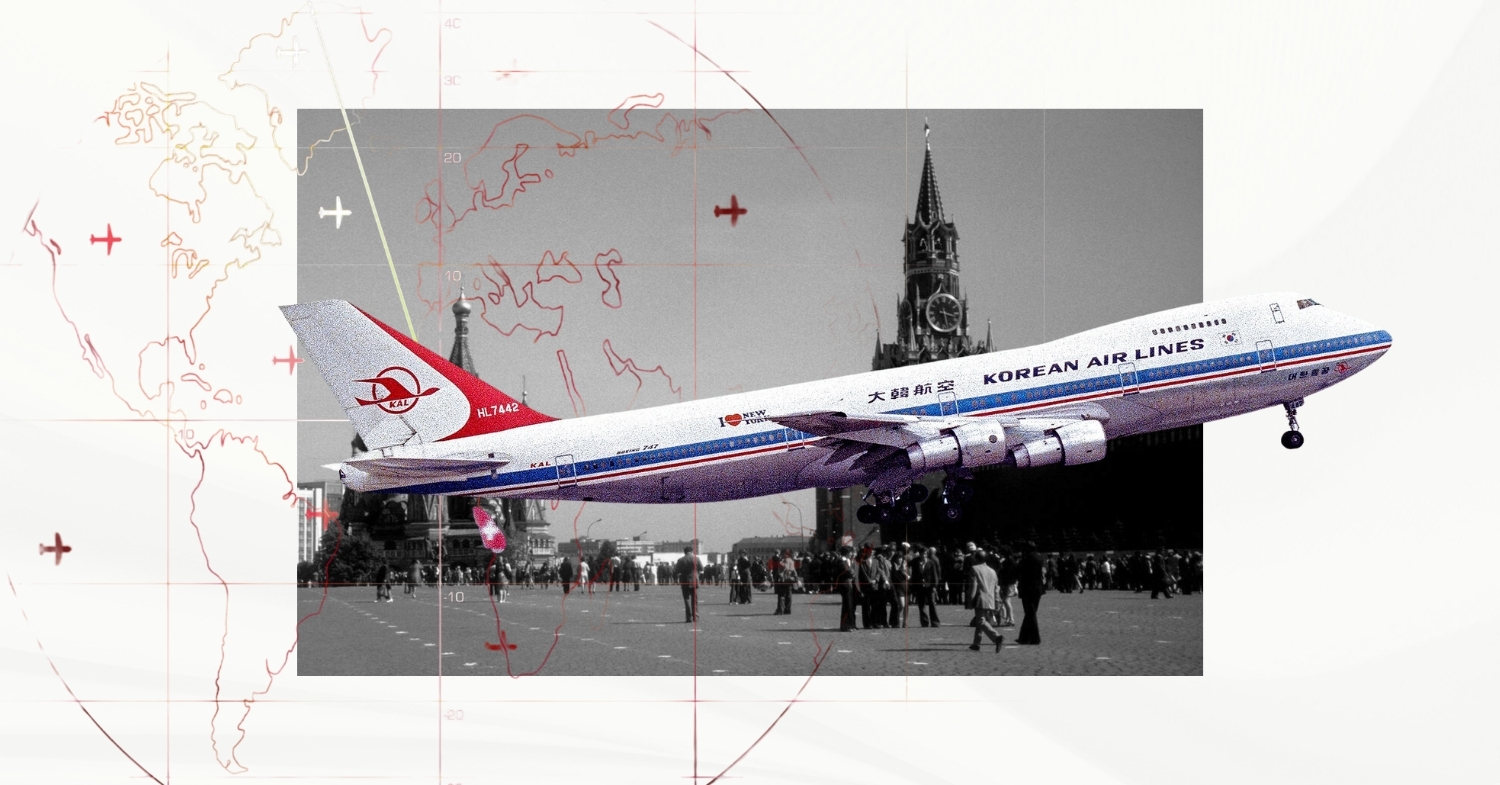
At 3:26 a.m. on September 1, 1983, a Soviet Su-15 fighter fired a missile into the side of a civilian Boeing 747. Korean Air Lines Flight 007 had strayed into Soviet airspace over Sakhalin Island, carrying 269 people – including a sitting U.S. congressman – from New York to Seoul. The plane broke apart over the Sea of Japan. There were no survivors.
For days, Moscow said nothing happened at all.
When silence became impossible, the Kremlin shifted to denial, then to justification, then to blaming the victims. “Despite the savagery of their crime,” President Reagan told the nation four days later, “the Soviets still refuse to tell the truth. They have persistently refused to admit that their pilot fired on the Korean aircraft. Indeed, they have not even told their own people that a plane was shot down.” Soviet officials claimed no missile had been fired. Then they claimed the plane had been a spy aircraft, sent deliberately to test Soviet defenses. Then they claimed the pilot had acted correctly against a hostile intruder, and that any deaths were the fault of American and South Korean provocation. It took the Soviet Union six days to admit it had shot the plane down at all, and even then, only to insist it had been justified.
This was not improvisation. It was a Soviet strategy tried and tested.
In 1940, Soviet secret police executed 22,000 Polish military officers and intellectuals in the Katyn Forest on Stalin’s direct order. For 50 years, Moscow blamed the massacre on Nazi Germany – fabricating forensic reports, staging a rigged tribunal, and maintaining the lie through five decades of Cold War diplomacy, official commemorations, and state textbooks. The Soviet Union only admitted the truth in April 1990, months before it ceased to exist, when the weight of the evidence had become impossible to keep suppressed any longer – and even then, the admission named only three of the execution sites and understated the death toll by thousands.
Deny. Reframe. Blame the victim. Wait out the world’s attention span. The Kremlin did not retire this playbook with the Soviet Union, either.
Through two wars in Chechnya spanning more than a decade, Moscow described the flattening of Grozny as a counter-terrorism operation, denied targeting civilians its own soldiers openly discussed targeting, and insisted, at every stage, that the war was nearly over. It was not, and the pattern of the denial – technically worded, endlessly repeated, indifferent to the evidence – should have been a warning for what came next.
On July 17, 2014, a Buk surface-to-air missile brought down Malaysia Airlines Flight 17 over eastern Ukraine, killing all 298 people on board. Within hours, Russian state media offered a rotating cast of alternate explanations – a Ukrainian jet, a Ukrainian missile, a body double for Vladimir Putin’s own plane, which had allegedly been the real target. The Joint Investigation Team, drawing on satellite imagery, intercepted communications, and forensic missile fragment analysis, later traced the weapon to Russia’s 53rd Anti-Aircraft Missile Brigade. A Dutch court convicted three men, two Russians and one Russian-backed separatist, in absentia in 2022.
Russia has never accepted responsibility. It has, instead, done exactly what the Soviet Union did in 1983, and exactly what it did about Katyn for half a century: deny, reframe, wait.
The technology changed. Propeller-driven denial became state television, then became coordinated social media disinformation. But the underlying instinct that truth is negotiable if you can outlast the news cycle has survived three different Russian political systems, two different centuries, and at least three mass-casualty events involving civilian aircraft, hundreds of miles apart, decades apart, with strikingly identical scripts.
This is not a coincidence, and it is not a coincidence worth treating gently. A government does not accidentally develop the same reflex three times across eighty years unless that reflex is structural, built into how the system survives contact with its own atrocities.
The passengers of KAL007 and MH17 have almost nothing in common except how their deaths were handled by the state responsible for them: denied first, minimized second, and eventually, if the world stopped watching for long enough, quietly absorbed into the background noise of things Moscow insists never really happened the way everyone knows they happened.
Remembering KAL007 is not just about honoring 269 people who boarded a plane and never arrived. It is about refusing to let a government run the same script a fourth time.