
Sep 21
Surviving Communist Albania
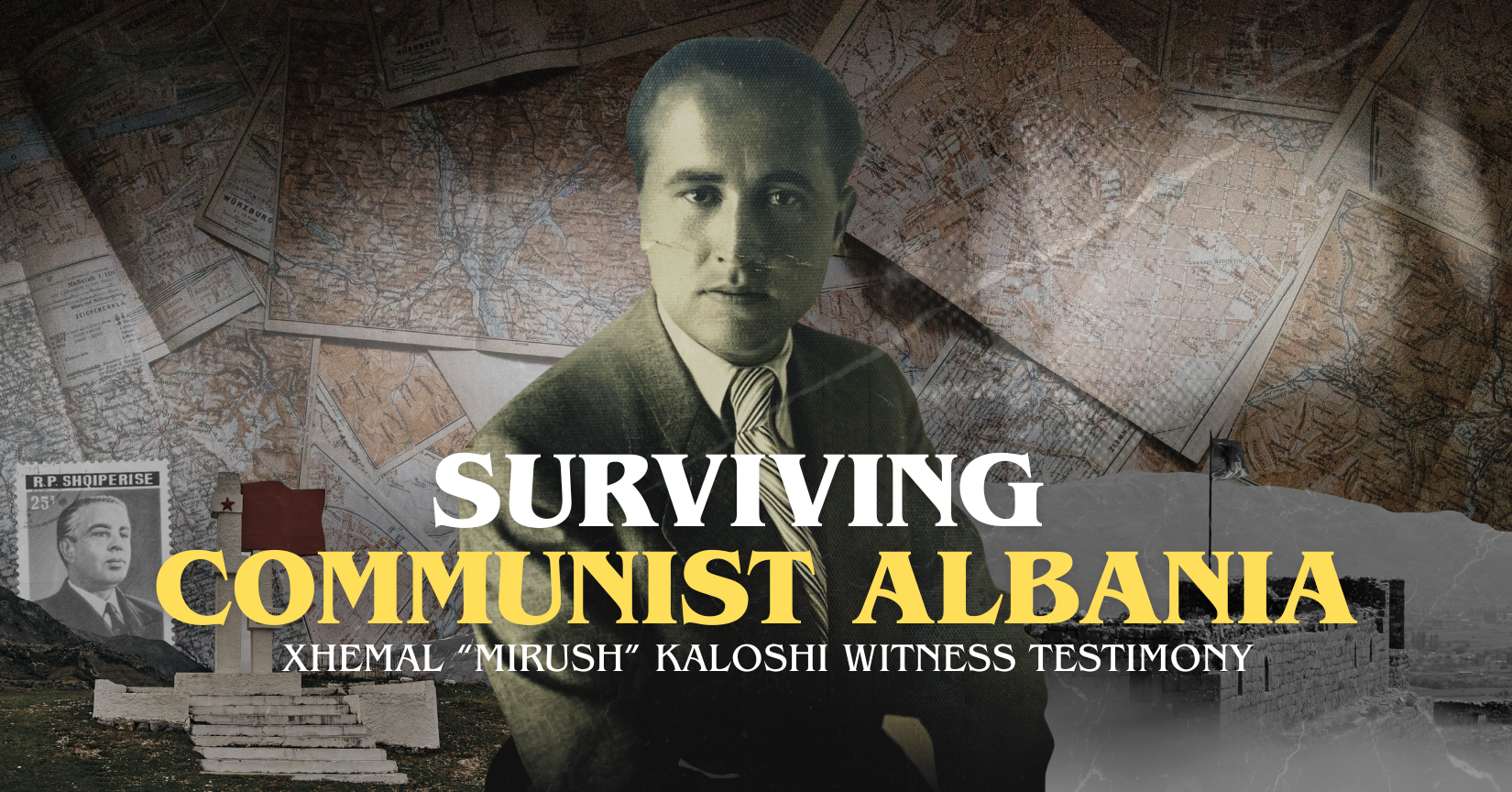
I was a 35-year-old elementary school teacher, a young man whose joy was in shaping young minds. On August 17, 1947, as I went to collect my monthly salary, I was arrested. No explanation, no crime, no warrant. From that moment, I ceased to be a teacher and became a prisoner of suspicion.
This is my testimony. It is not a tale of extraordinary heroism but of ordinary suffering, endured by thousands whose only misfortune was to live under a dictatorial communist regime that valued control, fear, terror, physical, and mental torture above reason and life. I write not only so that you may know what happened to me, but so that you may understand what such dictatorial communist regimes do to society, families, life, and to a nation. I came close to death many times, yet somehow, I am alive to write these words. Many others are not.
The Arrest and Trial
In prison, I witnessed the methods of psychological annihilation. A colonel once entered our cell spitting insults such as: “filth,” “dung,” words meant to break not only the man but his spirit.
When my turn came, I was thrown into a basement, tied, without food or bedding. The following day I faced the chief of security. “Confess your crimes,” he ordered. I had none. My denial enraged him. He kicked me so hard in the shin that I collapsed unconscious on the concrete floor. That blow nearly shattered my leg, and for hours I lay close to death. But I refused to sign the confession he had prepared.
At my trial, the verdict was already written. Witnesses, pressed or bribed, testified against me. I was labeled a fascist, a collaborator, a propagandist. I refuted each charge, and my lawyer declared the accusations baseless. The prosecutor, however, demanded three years of imprisonment and the confiscation of my property. The court delivered the sentence as expected. I was guilty not of deeds, but of existing in a political system that needed enemies.
The Labor Camp of Maliq – Albania’s Dachau
From prison, I was transported with thousands of other prisoners to the swamp fields of Maliq, (a small town in southeast Albania, not too far from Lake Ohrid) to the labor camp of Vllocisht modeled after the concentration camp of Dachau in Germany. It was a camp designed not to reform nor re-educate prisoners, but to crush, a camp where survival was the only victory. There, human life was treated as expendable material, useful only so long as it could dig canals and marshes through mud. This was forced labor.
The conditions defy imagination. We were forced to work from Monday-Saturday between the hours of 4:00a.m.-7:00p.m., barefoot, clad in rags, freezing in the highland cold. Tools were scarce and broken; often we tore at the swamp with our bare hands. The mud cut our flesh, thorns shredded our skin, and lice swarmed over our bodies. Later, the authorities set quotas: each man was to dig five cubic meters of earth daily. Those who lagged were beaten and tortured mercilessly. The cold pierced our bones. Sunday “rest days” were the worst: no food, endless roll calls, endless hunger. Men, filthy and ragged, fell into animal-like behavior. Hunger became our constant companion.
Food was starvation rations. A piece of bread, a watered-down soup, a few beans. Men wasted away to skin and bones. Desperation gave birth to theft. Bread was sold for the price of gold. Shoes were stolen, leaving many barefoot in icy swamps. A black market emerged even within the camp, a grotesque parody of economic life where survival was the only currency.
Hunger erased dignity and logic beyond reason. I saw men eat potato peels and onion stalks from drainage ditches. I remember a fellow teacher too weak to stand, crawling on his elbows, reaching for watermelon rinds discarded in the mud. His eyes bulging from hunger, his lips cracked and bleeding searching for one more bite of life. I tore off a small piece of watermelon from my food ration and placed it in his trembling hands. He looked at me as though I had given him life itself. He could not speak; his strength was gone. But his eyes, glistening with tears and a weak hand gesture thanked me.
Epidemics of lice and dysentery swept through the camp, devouring men as mercilessly as the hunger that already consumed us. Disease spread like wildfire. Lice crawled across our skin, biting until blood ran. Men scratched themselves raw. Some burned their blankets in despair, saying, “Better to die of cold than live without sleep.” Torture was routine. Every day, men were beaten until bones snapped, or heads were shoved into the swamp until they nearly drowned. Those who faltered under the weight of exhaustion were whipped. Some prisoners, crushed by despair, committed suicide. A sixteen-year-old boy hung himself after his food portion was stolen-he could not endure another day of starvation. Others were shot, accused of trying to escape when in truth they had been lured into a trap. I, too, felt the blows, the suffocating water, the cracking whip. Time and again, I was pushed to the edge of death. I withered to 35 kilograms (77 pounds), scarcely more than half my former self. Once, I lay flat on the ground, unable to rise, resigned to the end. Only a rare moment of pity from a guard—who spared me another beating—allowed me to survive that day. Any moment could have been my last. I might have died in the mud, left unburied, forgotten, another nameless shadow lost to the swamp. And yet, time after time, I clung to life. Whether by chance, by sheer stubbornness, or by some power greater than myself that refused to let me go—I endured.
By the time we left Maliqi labor camp, 150 prisoners had perished. They were buried namelessly in the swamp, discarded like scraps. Their families never saw their bodies. The camp was a factory of suffering. I walked out alive, though little more than a skeleton.
Return to Prison
When we were marched back to Durrës (a coastal city in central Albania) prison, families came to see us, except that we were beyond recognition. Mothers stared into our hollow faces and wept, unsure if these skeletons in rags were their sons. My sister Bardhoshe came early in the morning to bring me food. She searched for my face and thought I was a stranger. Only when I spoke did she know. Then she collapsed into tears. All around me, the same scene repeated. Mothers, fathers, sisters looked at skeletons who used to be their loved ones. They wept. Prisoners shouted for nothing but bread. “We want bread, we want bread!” they cried. It was not delicacies they sought, only the simple fullness of a meal.
For days, families brought food in abundance, and we devoured it with desperation that frightened even ourselves. For two weeks, families were allowed to visit every day, bringing food. Men devoured it like wolves, unable to stop. Some collapsed from overeating, their stomachs unable to handle the sudden abundance. We were not men; we were starving shadows.
Amnesty
On April 29, 1949, we were called into the prison courtyard. Officials announced we were forgiven for our “crimes” because of our “good work” draining the swamp. They read out names, and prisoners wept as they stepped forward. When they called my name, my legs trembled, I could hardly believe it. I lived through nights of beating, days of hunger, months in mud and humiliation. I was close to death more times than I could count. After two years of false accusations, of hunger and humiliation, I was free. Yet freedom came with great sorrow. Behind me, friends remained—men I had lived, suffered, and starved with. To leave while others remained felt like betrayal, even as it was salvation. I left the prison gates free in body but not in spirit.
But what followed was, in many ways, even more isolating. I had survived forced labor in the concentration camp and walked out of the prison gates, only to discover that the entire nation had become the greater cage. Returning to my former profession was nearly impossible, as political stigma rendered reintegration into intellectual or professional life unthinkable. Marriage carried its own penalties: a spouse would be subjected to expulsion, compulsory labor, and routine social humiliation. The heaviest burden, however, fell upon our children. Access to higher education was systematically restricted, with the family’s political background often outweighing academic merit. Children of those labeled “undesirable”—former prisoners, nobility, landowners, clergy, or individuals associated with pre-communist governments—were excluded or severely disadvantaged. Even when admission was granted, the freedom to choose a field of study did not exist; the state dictated both the number of places available, and the disciplines deemed necessary for its ideological and economic agenda.
In practice, this meant that education became not a right, but a privilege allocated by political conformity. My own family experienced this directly with our five children. For my daughter in particular, a straight “A” student throughout her life, to secure the right to attend college, my wife was compelled to spend five months petitioning education authorities. Her determination and persistence extended to sleeping outside the Ministry of Education until, at last, she was handed a single official document granting our daughter the right to attend college. That single sheet of paper determined the course of a young life—an emblem of how individual futures were controlled, rationed, and politicized by the regime.
This was not only personal—it was systemic. Access to higher education was strictly limited, reserved for a small fraction of graduates. Admission was not determined by merit, but by loyalty to the Communist Party. Academic talent mattered less than political obedience.
The toll was enormous. Humanly, people lived in constant humiliation, denied dignity and autonomy. Financially, entire generations were prevented from pursuing professions that matched their abilities, crippling personal and national development. Emotionally, the trauma scarred families, teaching children not hope but silence. Socially, trust dissolved: neighbors and family members turned into informants, friends into strangers, teachers into tools of propaganda.
Why Dictatorial Communist Regimes Destroy Humanity
My story is not only personal. It is the anatomy of what happens under totalitarian rule.
Let me explain in terms I hope you, as students and future leaders, will consider carefully:
A dictatorial communist regime is destructive because it thrives on fear, not freedom, on conformity, not dignity. It crushes the individual by reducing people to instruments of labor and suspicion, denying them the basic rights to think, to speak, to love, and even to dream for their children. Human life is devalued, families are broken, and entire generations are robbed of education and opportunity. Financial progress stalls when merit is silenced by ideology, and society itself erodes as trust is replaced by surveillance and betrayal. Such a system does not build a nation—it empties it, leaving behind only silence, scars, and shadows of what humanity could have been.
A Final Reflection
What I endured was not only my story, but the story of thousands silenced by a system that thrived on fear. I was arrested without crime, condemned without justice, and nearly worked to death in the mud of Maliq concentration camp. I survived beatings, hunger, disease, and despair—when so many others did not. To live was not triumph but burden, for survival meant carrying their memory.
Yet beyond the barbed wire, I discovered the greater prison: a nation stripped of freedom. Families lived in suspicion, neighbors betrayed one another, and children were punished for the supposed sins of their parents. Education, once the ladder of hope, became a privilege granted only to the politically obedient. Dreams were rationed, futures were written not by merit but by ideology.
This is why dictatorial communist regimes must be understood for what they are: not systems of justice or equality, but machines of dehumanization. They do not merely destroy individuals—they corrode the very fabric of society. Human dignity, family bonds, intellectual growth, and social trust—all are ground into dust beneath the weight of tyranny.
Freedom, dignity, and justice are not luxuries. They are the foundations of human life, the air we breathe. Without them, people become shadows, and nations collapse into ruins. To cherish freedom is not only to honor those who died without it, but to guard against its loss for future generations. For survival itself carries responsibility, the responsibility to tell the truth of what happens when power is allowed to treat human beings as less than human.
No ideology, no regime, no power is worth the price of a single human life. And yet, in those years, hundreds, thousands were spent like coins tossed into the mud. Guard your freedom fiercely, because once it is gone, nothing, not even tears, can bring back the breath of the dead.
This witness testimony was written by Xhemal “Mirush” Kaloshi in 1975 and provided to the Victims of Communism Memorial Foundation by his family.