
Feb 20
Reagan’s Birthday Gift
Forty years ago, today, Ronald Reagan had a busy birthday, including speeches to large gatherings of federal employees at the Departments of Treasury and Health & Human Services. His schedule for the day suggests an intimate birthday dinner in the residence that evening.
His birthday present would arrive later.
On Feb. 11, 1986, Natan Sharansky was released from prison in the Soviet Union and allowed to emigrate. President Reagan had worked hard to persuade Soviet Secretary General Mikhail Gorbachev to release Sharansky, a Jewish refusenik. Sharansky was among the most vocal human rights activists who were refused visas to leave the Soviet Union.
Sharansky was imprisoned in 1978, during the presidency of Jimmy Carter. Carter, like his predecessors, had largely sought to manage relations with the Soviet Union, including recognition of a Soviet sphere of influence that included captive nations in Eastern Europe and Central Asia. Under Nixon, Ford, and Carter, a policy of détente, meaning an easing of tensions, seemed to recognize the Soviet colossus as legitimate and an enduring reality in international politics.
Ronald Reagan changed all of that. On March 8, 1983, Reagan gave a speech to the National Association of Evangelicals that largely focused on domestic policy matters such as abortion, education, and parental rights. It was during that speech that he overrode his policy advisors and boldly called out the “aggressive impulses of an evil empire.”
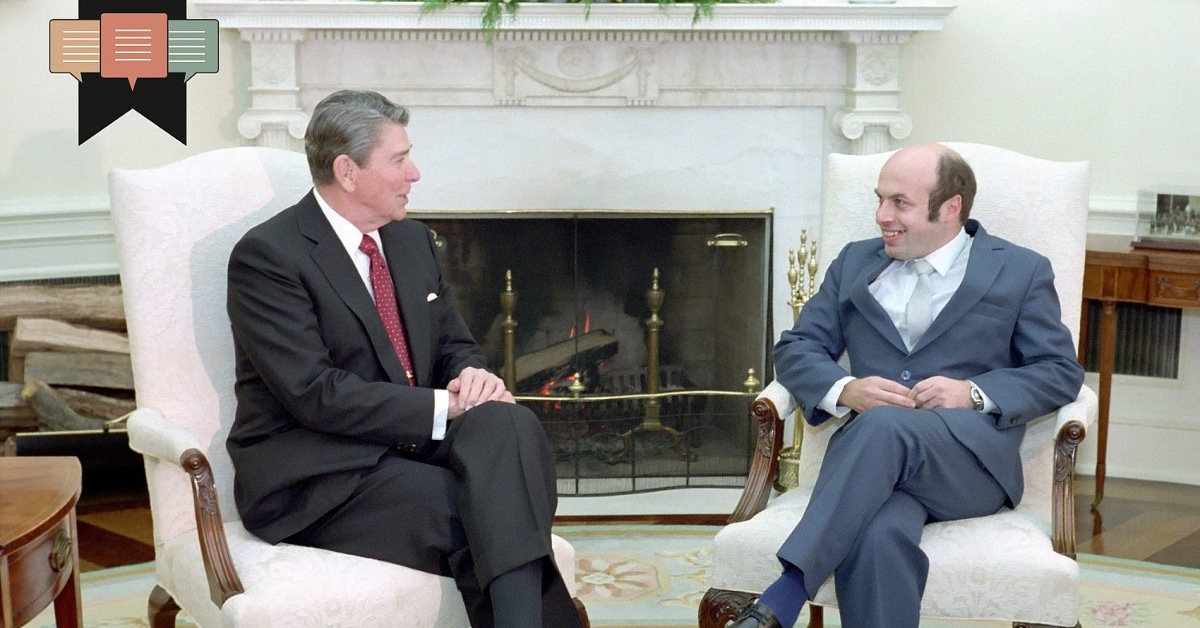
When Sharansky visited Reagan at the White House, Sharansky told the president that he and his fellow inmates celebrated when they learned that Reagan had called out the evils of communism and Soviet totalitarianism. He said there were ways to communicate even under the harsh conditions of prison, and word spread quickly about the evil empire speech. Sharansky recalled the following in his memoir:
Tapping on walls and talking through toilets, word of Reagan’s “provocation” quickly spread throughout the prison. We dissidents were ecstatic. Finally, the leader of the free world had spoken the truth—a truth that burned inside the heart of each and every one of us. I never imagined that three years later I would be in the White House telling this story to the president. … Reagan was right and his critics were wrong.
Elsewhere in the speech, Reagan called the communists “the focus of evil in the modern world:”
Yes, let us pray for the salvation of all of those who live in that totalitarian darkness—pray they will discover the joy of knowing God. But until they do, let us be aware that while they preach the supremacy of the State, declare its omnipotence over individual man, and predict its eventual domination of all peoples on the earth, they are the focus of evil in the modern world.
This is what electrified Sharansky and his fellow prisoners.
The release of Sharansky was a gift for Reagan and was the result of what The Washington Post and others have reported as his “quiet diplomacy.” From early in office, Reagan directed the State Department to step up its advocacy for human rights activists, religious authorities, members of the press, and others harassed and imprisoned by the Soviet Union and other communist regimes. Also of interest, as Kent Hill has documented, were a small group of Soviet Pentecostals (some of whom sought refuge in the basement of the U.S. Embassy in Moscow) and thousands of Soviet Jews who wished to emigrate to Israel or the West. Despite the so-called equality and anti-racism of communism, anti-Semitism was routine across the communist bloc.
Reagan wrote numerous personal letters to Soviet leaders, asking them to act with mercy on behalf of these communities. However, the turnover of Soviet gerontocrats (three Soviet leaders died by the beginning of Reagan’s second term) and the glacial culture of fear made change difficult. When Gorbachev took power, he was handed an envelope by U.S. Vice President George H.W. Bush. In his short letter, Reagan proposed a personal meeting between the leaders and emphasized the human rights issue, “I am sure you are aware that American interest in progress on humanitarian issues remains as strong as ever.”
Reagan was a great champion for human rights and an active campaigner to release those held in prison. His example has been followed by later presidents, with perhaps the best known case in recent years being the release of Pastor Andrew Brunson after direct intervention by President Donald Trump.
In the White House’s record of Reagan’s immediate response to Sharansky’s release, Reagan telephoned Sharansky and “commended his courage and fortitude as symbols of the human will for freedom.”
As we reflect on the powerful legacy of Ronald Reagan this Feb. 6, we should not overlook his “quiet diplomacy” that helped set so many captives free, and the role that America has as a force for good around the world.
This article, written by VOC President and CEO Dr. Eric Patterson, was originally published in WORLD. The views and opinions expressed by the author do not necessarily reflect the opinions of the Victims of Communism Memorial Foundation.